





The milestone of March 1, 2026, marks a revolution in asset management in Vietnam: the birth of the "Real Estate Digital ID." In a context where the real estate market is transforming strongly toward transparency, assigning a unique "Identification Code" to every land plot, apartment, or office floor is not just a technical requirement but also a solid legal shield for both investors and businesses. This article, produced by the expert team at Altas Corp, provides a comprehensive overview—from definitions and legal regulations to the practical benefits of the Real Estate Digital ID in the digital age.
 The 2026 Real Estate Digital ID is a turning point for transparency in Vietnam's property market.
1. What is a Real Estate Digital ID? Decoding the 40-Character Identification Structure
A Real Estate Digital ID (also known as an Electronic Real Estate Identification Code) is a unique string of characters (up to 40 characters, including both numbers and letters) issued by the national database system specifically for each real estate product.
1.1. The Essence of Digital Asset Identification
Similar to a Citizen Identity Card (CCCD) number identifying an individual, the Real Estate Digital ID identifies a fixed asset entity. This code is non-duplicable nationwide and follows the asset throughout its "lifecycle": from being a project on paper and future-formed assets to receiving a title deed and being traded on the market.
1.2. Structure of the Real Estate Identification Code
According to the guidelines in Appendix I of Decree 357/2025/ND-CP regarding the construction and management of information systems and databases on housing and the real estate market, this code is automatically generated based on:
- Land Plot Identification Code: Identifies the province, city, and district where the asset is located. A specific land plot has only one unique ID nationwide.
- Project and Construction Information Code: Reflects the administrative unit, approval year, type, level, adjustment status, and a random identification number.
- Location Identification Code (if any): Issued by the National Land Database system.
- Natural Character String: A unique identification character for the product's sequence number.
This standardization allows management agencies (Ministry of Construction, Ministry of Natural Resources & Environment, Ministry of Public Security) to interconnect data instantly.
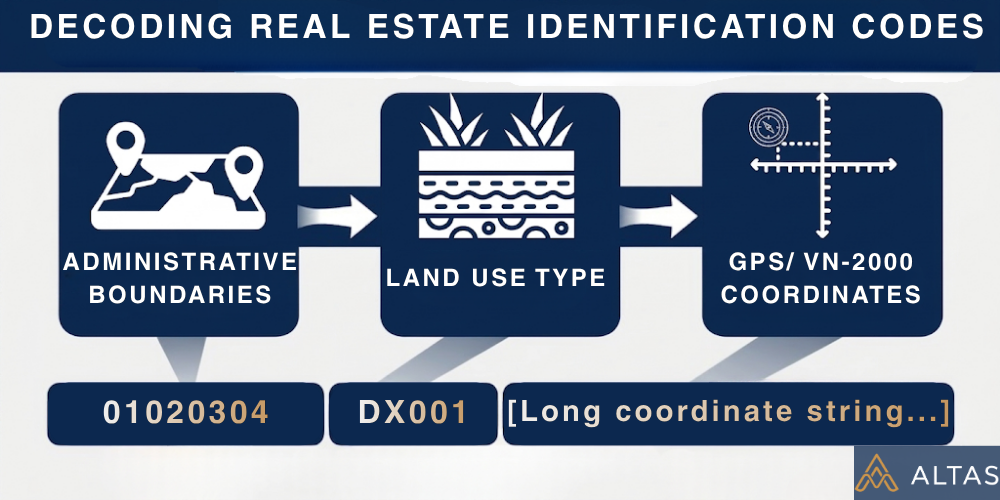 The property ID structure helps digitalize and clarify property history, ensuring market transparency.
2. Legal Regulations and the 2025–2026 Implementation Roadmap
The emergence of the Real Estate Digital ID is not an isolated event but the result of a methodical legal roadmap.
2.1. Core Legal Basis
This identification system is based on the following legal pillars:
- Law on Real Estate Business 2023: Regulations on building an information system for housing and the real estate market.
- Land Law 2024: Promoting the digitalization of "Red Books" (Land Use Rights Certificates) and the creation of digital cadastral maps.
- Decree 357/2025/ND-CP: Detailed regulations on issuing a unique identification code for real estate products starting from March 1, 2026.
2.2. Mandatory Subjects for Application
All of the following assets must be attached to an electronic identification code:
- Land plots (agricultural land, residential land, production and business land).
- Individual houses (villas, townhouses).
- Condominium apartments.
- Construction floor areas in commercial and office projects (Officetels, Shophouses).
 Digital IDs help clarify property history and prevent the risk of fake land titles.
3. Why is 2026 the "Era of Transparency" for the Real Estate Market?
The Vietnamese real estate market has long faced risks regarding information asymmetry. The introduction of the digital ID in March 2026 will thoroughly solve three major problems:
3.1. Complete Elimination of "Ghost Projects" and Fraudulent Sales
In the past, buyers often fell into traps where one plot of land was sold to multiple people via handwritten papers or fake titles. With the digital ID, all information regarding the asset's legal history is displayed publicly on the system. If an identification code is under "transaction prevention" or "mortgaged" status, the system will alert immediately.
3.2. Public Disclosure of Planning and Price Fluctuation History
The Real Estate Identification Code is directly connected to digital maps (GIS). Citizens can look up:
- Is the asset located within an area slated for clearance or planning?
- The history of previous owners.
- Actual transaction values over the years (preventing artificial "price inflation").
3.3. Tightening Tax Management and Bank Payments
In 2026, the mandatory requirement to pay for real estate transactions through banks, combined with the identification code, will help the State control cash flow, combat money laundering, and prevent tax loss. This is the key factor in bringing real estate values back to their true worth.
4. Detailed Guide to Real Estate Identification Code Lookup
Citizens and businesses can access Real Estate Digital ID information through three official channels:
4.1. Lookup via the VNeID Application (The Most Popular Channel)
The property ID will be linked to the owner's Citizen ID (CCCD) number.
- Step 1: Log in to VNeID (Level 2).
- Step 2: Access the "Asset Management" section → "Real Estate."
- Step 3: The system displays a list of assets under your name with the corresponding identification codes.
4.2. Lookup on Portals of the Ministry of Construction & Ministry of Natural Resources and Environment
Online public service portals will allow ID lookups if you have information such as the map sheet number, plot number, or plot coordinates. This is extremely useful for investors wanting to check the "legal cleanliness" of an asset before making a deposit.
4.3. Confirmation at the Land Registration Office
For complex transactions or old assets not yet updated on the digital system, citizens can request an identification information extract directly from local authorities.
5. Legal Digitalization: The Foundation for Operating Digital IDs
To obtain an identification code, data from paper "Red Books" must undergo a Legal Digitalization process. This is a rigorous technical and legal procedure.
5.1. Building the National Land Database (VBDL)
The goal by 2026 is for Vietnam to complete the digitalization of 100% of cadastral data. This data includes:
- Spatial Data: Precise coordinates for every square meter and land plot boundaries on satellite maps.
- Attribute Data: Legal information associated with that land plot.
5.2. The Right to "Real-time Fluctuation Notifications"
A superior benefit of digitalization is asset protection. If there are any changes (mortgages, transfers, distraints) related to your Real Estate Identification Code, the system will send a notification to your phone (via VNeID or SMS). This gives owners total peace of mind against the risk of "stolen title transfers."
6. Connection between Real Estate Digital IDs and Personal Data Protection (PDPL)
As discussed in the topics regarding Decree 356/2025/ND-CP (PDPL), the management of real estate IDs must strictly comply with data security regulations.
- Privacy: Only authorized parties or parties authorized by the owner (via OTP or digital authentication) have the right to deep access detailed asset information.
- Data Safety: The national asset identification system is operated on the highest level of cybersecurity infrastructure to prevent unauthorized data mining for spam advertising or fraud.
7. Challenges and Notes for Property Owners
Despite the benefits, transitioning to a Real Estate Digital ID poses several challenges:
- Updating Old Titles: Titles issued many years ago often lack VN-2000 coordinates. Owners need to proactively conduct re-measurements and update data to be issued an accurate ID.
- Information Correction: If information on the digital system differs from the paper version, correction procedures must be performed immediately to avoid trouble during future transactions.
- The End of "Handwritten Transactions": Transactions not processed through a notary and not updated with an identification code will be considered illegal and will not be protected by law starting in 2026.
 Altas’s Real Estate Digital ID screening and consulting solutions.
8. Altas Corp: Your Partner in the Real Estate Legal Digitalization Roadmap
At Altas Corp, we understand that grasping the regulations on Real Estate Digital IDs is vital to protecting and increasing asset value for businesses and investors.
We provide specialized solutions:
- Real Estate Legal Audit: Checking the compatibility of paper records with the national digital data system.
- Identification Code Update Consulting: Supporting the procedures for measurement and coordinate standardization to integrate assets into VNeID.
- Digital Asset Portfolio Management: Helping businesses with large land banks manage information centrally and transparently through identification codes.
Let Altas Corp accompany you on the digitalization journey, turning identification numbers into absolute peace of mind.
CONCLUSION
The Real Estate Digital ID 2026 is not just a technical number; it is a symbol of a civilized, transparent, and safe real estate market. Proactively learning and adapting to this regulation is the best way to protect your "digital assets" in the future.
Fixed Contact Information:
- HCMC Office: 5th Floor, 37 Ky Con, Nguyen Thai Binh Ward, District 1.
- Hanoi Office: 12th Floor, Mipec Tower, 229 Tay Son, Dong Da District.
- Bac Ninh Office: 4th Floor, Duong Tuan Building, No. 09 Le Thai To, Vo Cuong Ward.
- Hotline: +84 916 923 235 | Website: altas.vn
Content Responsibility: Marketing Team Leader at ALTAS Corp – Tran Tu Van.